Artist-in-residence Sheilah ReStack’s project in Sackville
This past winter, Canadian multimedia artist and former Mt.A artist-in-residence, Sheilah ReStack, involved the greater Tantramar community in her art installation: Archive of the Queer Embrace.
“I’m from Nova Scotia. I went to Mount Allison a long, long time ago. There, I had that kind of connection to rural space in Sackville,” ReStack said in an interview with The Argosy. She brings the aspect of rural Maritime life into her art piece, Archive of the Queer Embrace.
Through collaboration with students from Mt.A, as well as members of the community from as far as Fredericton, N.B., ReStack installed pieces of visible queer love around the parks of Sackville and beyond.
Archive of the Queer Embrace is a series of photograms picturing queer members of the local community holding something or someone they love. “I wanted to create a space to put something into the world around the experience of queerness in non-urban environments, and how you can infiltrate rural spaces too,” ReStack said about the premise of the project. “Part of the impetus of the project was myself growing up rural and queer, and feeling like there was a layer of invisibility…I think that was what drew me towards the project in the first place, was wanting to make images and involve community.”
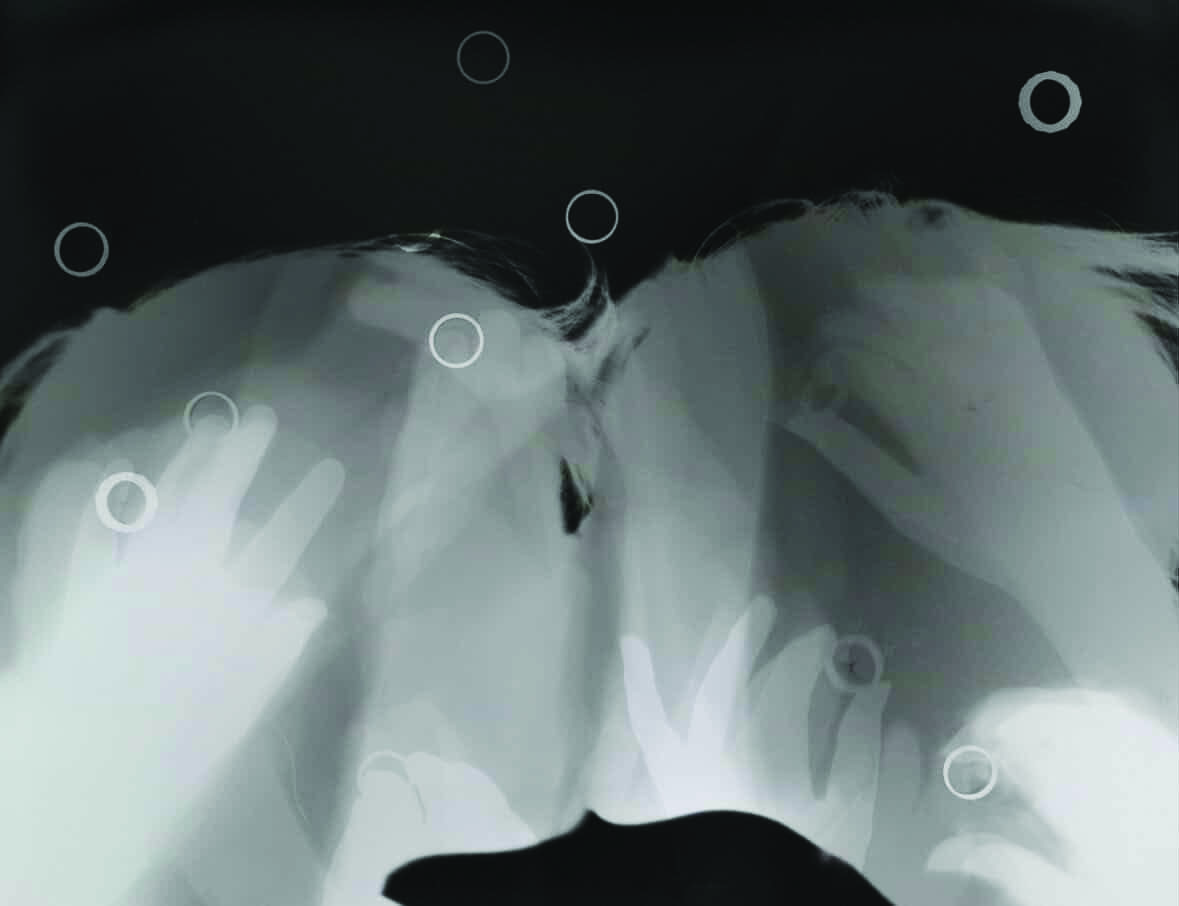
“This kind of curiosity goes all the way back from looking in archives in L.A.,” ReStack explained. She described the lack of queer representation in photography and art in the archives she has seen, with an emphasis on physical contact between women. “There was so much more when it came to articulations of images of men, you know, and I know there’s all kinds of histories that inflect how sexuality and gender get articulated into public space and image-making, but I’m looking for these archival images that somehow speaks to my own experience,” ReStack said.“I’m finding those to be lacking, and then wanting to make my own.”
The world “archive” is not chosen lightly. ReStack said, “there is a certain kind of irony of using the world archive, because, it’s like, what is an archive? In the context of minor histories, whether that be racialized or economic, or gender and sexuality, minor or non-dominant–these histories could be written on a napkin.”
In collaboration with Mt.A’s queer advocacy club, Catalyst, ReStack put out a call for queer portraits to the Sackville community in March. Over 50 members of the community participated, including people who heard about the project from a two-hour drive away, as well as Mt.A students and members of Catalyst.
With help from her interns and members of Catalyst, ReStack invited participants to a short interview, which would later air on CHMA. Participants then entered the dark room where the photograms were taken with something or someone they love. “It was pretty special to witness, because [participants] were thinking about how to place themselves and the objects onto the paper, or each other, and see people experimenting with making an image,” ReStack recounted. “It takes a certain amount of trust to…allow others to witness your creative process or be involved with that.”
Photograms are a camera-less photographic technique that creates a print by shining an enlarging light onto objects. The result is a silhouette print in black-and-white that is a direct copy of objects, or people, from the image. ReStack specifically chose this medium because of a “degree of opacity.” “You don’t have to make yourself legible to the dominant narrative,” she said, citing Édouard Glissant’s philosophy of opacity. “Why are we responsible to make ourselves transparent to this dominant, heteronormative white patriarchal society?”
The images are now permanently installed throughout Sackville as signs in several public spaces, and will later be published in 2026-2027 as part of a larger project. “It’s not in a gallery or anything, and the signs, they’re printed out aluminum, but eventually they will disintegrate. I feel like they’re documents that go into the world,” ReStack said.
For now, the images are still available for viewing to anyone walking through the parks, until they disintegrate in many years’ time.