Whether you use AI or not, it may be changing how you write
I don’t use artificial intelligence (AI) to write for me, but that doesn’t mean I’m not terrified of being accused of doing just that. I’ve heard people describe this as an “AI witch hunt:” students, writers, and artists becoming increasingly anxious that their work will be mistaken for AI-generated content. Some have even started adding disclaimers assuring audiences that their work is entirely human-made.
These fears have affected how I write. I now scan my work for AI alarm bells, worry whether a semicolon makes me sound like a large language model (LLM), and usually end up deleting it just to be safe. I don’t want AI influencing my writing; however, if I routinely change how I write because I’m afraid of sounding like AI, can I really pretend it isn’t influencing me?
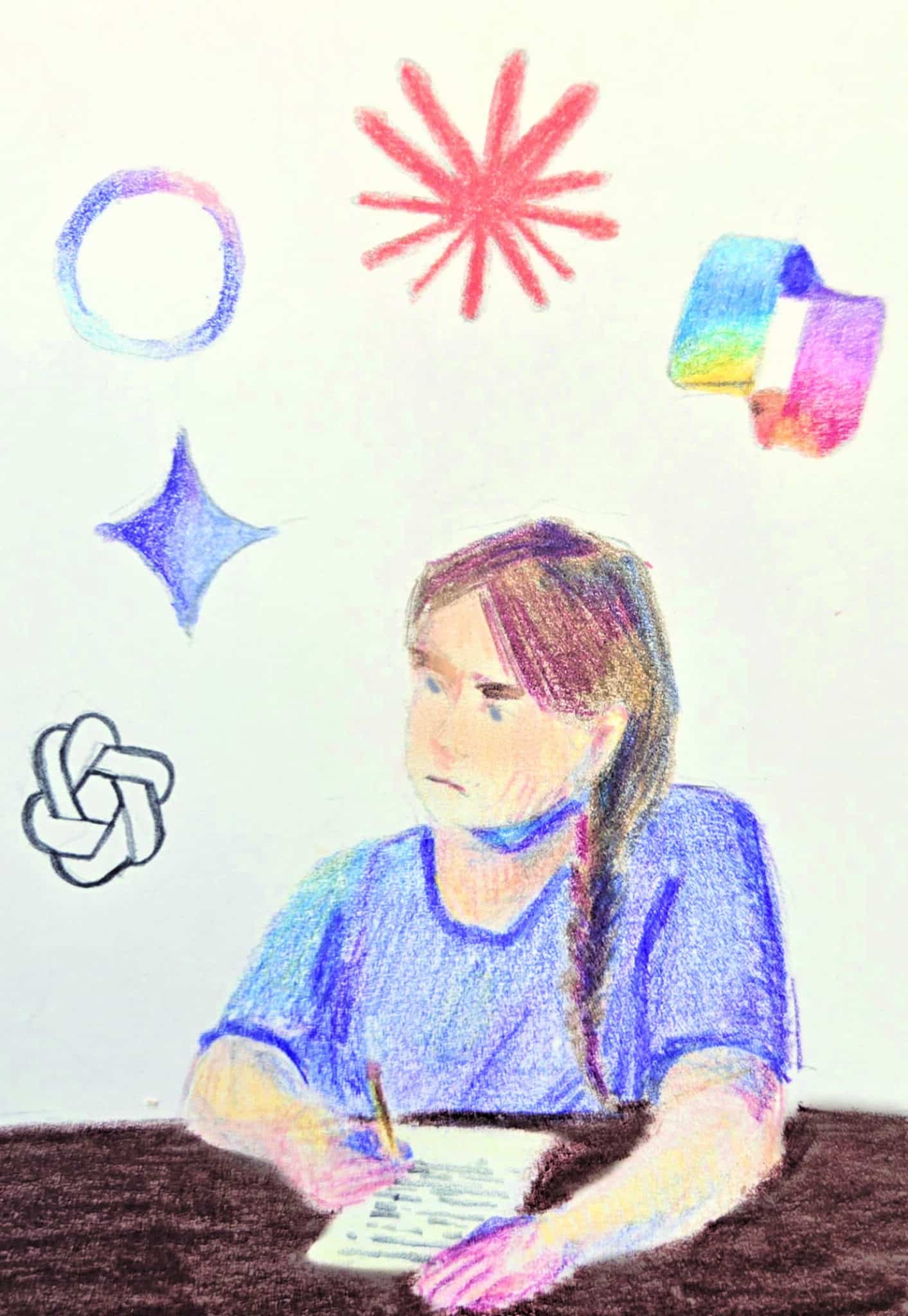
Generative AI is hardly the first technology to change how we write. Spellcheck, predictive text, and autocomplete have all influenced our word choices. But there’s a difference between correcting a typo and bulldozing an entire sentence to reconstruct it in a machine’s preferred image. Consider Grammarly: what began as a tool for checking grammar, spelling, and clarity, it now offers generative AI features that can rewrite text and produce new content. Why settle for a perfectly serviceable sentence when a machine can replace it with something more polished, professional and utterly devoid of your personality?
The problem extends beyond individual edits. We learn to write partly by reading; we absorb vocabulary, rhythms and sentence structures from the writing we encounter. If AI-generated writing becomes a larger part of that environment, it isn’t simply producing text alongside human writers. It is also becoming something human writers learn from.
A 2026 study published in Nature Human Behaviour examined more than 880,000 texts across seven datasets. Researchers found that using LLMs to rewrite existing text reduced variation in writing complexity by 21 to 50 per cent. In other words, the writing became more similar. When millions of people use similar tools to polish their work, how much individuality gets polished away?
Enter the AI writing clichés. “It’s not just X, it’s Y.” “In today’s rapidly changing world.” “This raises an important question.” “It’s important to note that…” None of these phrases were invented by AI; humans have been producing formulaic writing for centuries. But AI has made us suspicious of our own habits. A 2026 Pew Research Center analysis of nearly 490,000 webpages found that the use of certain patterns associated with AI writing had increased since ChatGPT’s release. The “it’s not just X, it’s Y” construction nearly tripled in use. I’ve avoided sentence structures I otherwise like because I’ve heard ChatGPT favours them. I also used more semicolons and em dashes in high school, before AI writing became so widespread. Imagine that: attending university to develop my writing, only to become afraid of using certain punctuation.
LLMs learn patterns from enormous amounts of text and use them to generate language that sounds coherent, professional, and familiar. But polished writing isn’t necessarily better. Human writers have favourite words, strange comparisons, and sentence structures they probably overuse. These quirks can make our writing recognizable. If machine-polished prose becomes our standard for good writing, more distinctive and artistic writing styles may start looking wrong simply because they don’t sound like the rudimentary sentences we’re accustomed to reading.
Which brings me to the question of how we decide whether something was written by a human at all. I tested this article using the first five detectors that appeared when I searched “AI detector” on Google. Grammarly decided 33 per cent was AI-written. GPTZero said there was a 100 per cent chance the piece was human-written and AI-polished, then promptly asked me to subscribe for $9.79 a month. What a steal! Scribbr disagreed, reporting that 92 per cent was human-written, 8 per cent was AI-written, and 0 per cent was AI-refined. TextGuard refused to show me a result without an account, which I did not sign up for. However, it did offer a “humanize text” button that rewrites your work using AI to make it sound more human, complete with a slideshow of five-star reviews. I feel like there may be some irony there. Finally, ZeroGPT (yes, a different website from GPTZero) declared the article 26.4 per cent AI-written. How specific.
If the same piece receives wildly different scores depending on which detector examines it, what exactly do those percentages mean? A 2023 study by Stanford researchers found that seven AI detectors misclassified more than half of the essays written by non-native English speakers in their sample as AI-generated, with an average false-positive rate of 61.3 per cent.
The consequences of getting it wrong extend beyond hurt feelings. A false accusation can threaten a student’s academic standing and damage their reputation. Some writing platforms, such as Google Docs, offer version histories showing how a document developed over time. But not everyone writes on platforms with these features. Do students have to save evidence of their own innocence just in case? Universities are still working out how to regulate AI, yet students can face serious consequences when the rules and the evidence remain far from straightforward.
In 2025, ABC News reported that Australian Catholic University had nearly 6,000 alleged academic misconduct cases in 2024, around 90 per cent of which involved AI. The university argued the reported figures were overstated, but acknowledged that approximately one-quarter of all referrals were dismissed after investigation. One student, Madeleine, was accused of using AI to cheat on an assignment while completing her final-year nursing placement. It took six months for the university to clear her, and her academic results were withheld during the investigation. She believed the delay contributed to her difficulty securing a graduate position.
I’ve increasingly fallen into the trap of second-guessing my own writing because I know someone might mistake it for a machine’s. I have to remind myself that my writing is human because I am, in fact, a human writing it. I don’t want to use AI to write, and I don’t want the fear of being accused of using it to determine how I write, either. Maybe resisting AI’s influence doesn’t mean memorising every phrase ChatGPT supposedly likes. Maybe it means recognising what makes our own writing sound like us. If we’re all learning to write from the same machine, we risk losing the individual voices that make writing worth reading in the first place.