Debut book by Khalil Akhtar encourages home cooks to embrace concision
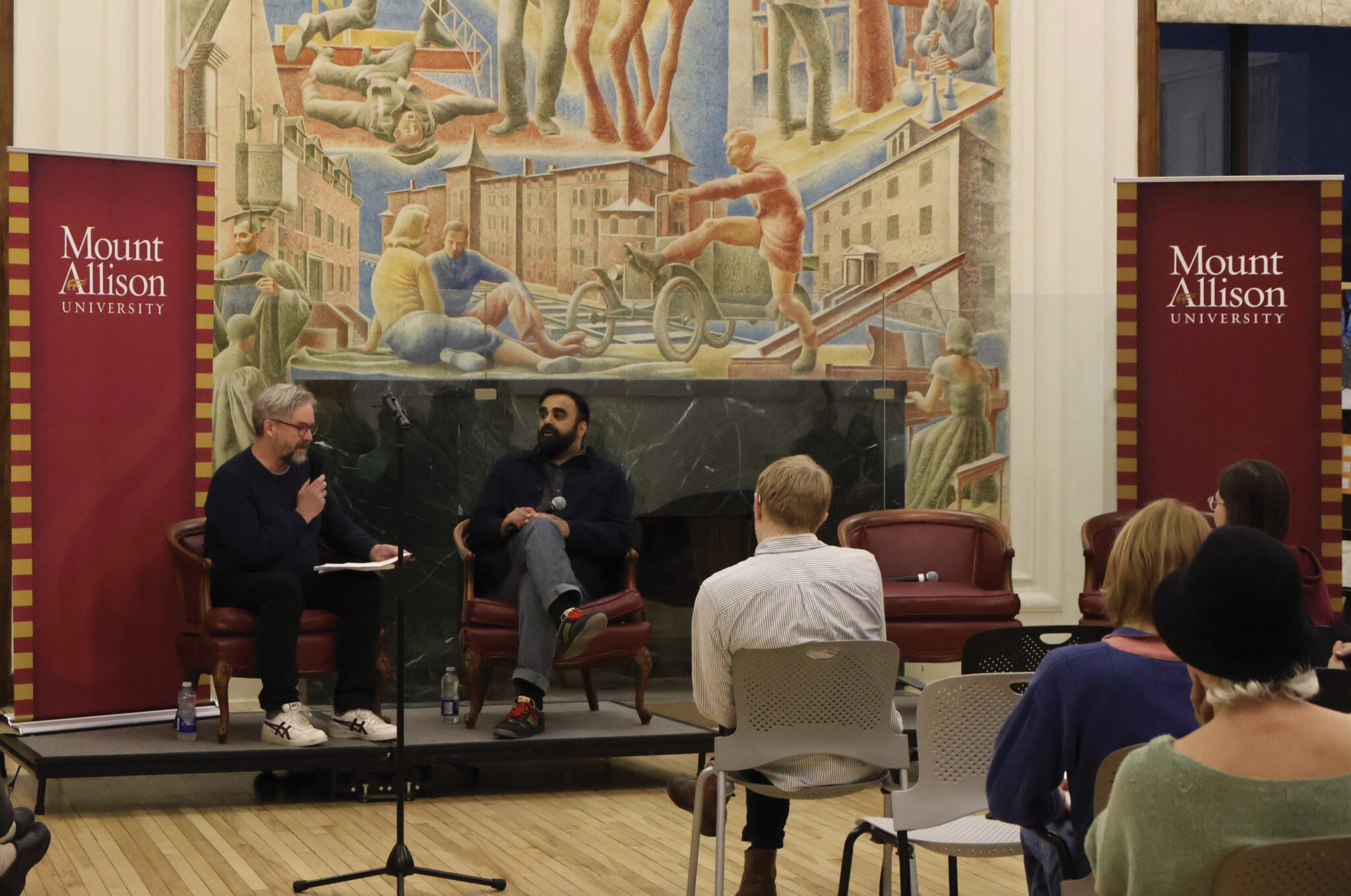
On Thursday, Oct. 8, Khalil Akhtar, host of CBC’s Information Morning Moncton, launched his book How to Eat with Your Hands: Roti Shoti and Other Ways to Settle In in Mt.A’s Tweedie Hall. Containing both recipes and essays, How to Eat with Your Hands is a meditation on Punjabi home cooking, the domestic kitchen, and the power of constraints while making meals.
Akhtar was interviewed at the launch by Sackville-based author and artist Jon Claytor. Claytor described How to Eat with Your Hands as a “philosophical” piece of writing about “memories [and] learning to cook in the family kitchen.” During the interview and a follow-up Q & A, Akhtar reflected on his relationship to the kitchen while growing up. He also spoke about how to develop a cooking practice consisting of a small number of meals that become muscle memory.
Akhtar said that his biggest advice to someone feeling alienated from the kitchen is to “spend a year with a cuisine you love.” In doing so, home cooks can find a range of 15-20 meals to make over and over, seeing how ingredients are repeated and rearranged.
How to Eat with Your Hands explores the multitude of choices present in modern home kitchens. “We as humans have never had it so good in terms of the food we can eat,” Akhtar said to Claytor. Until recently, Aktar explained, many home cooks would make meals from one cuisine for their entire lives. Now, the options are endless: Akhtar used the example of eating sushi on Tuesday and spaghetti carbonara on Wednesday. With the rise of available recipes and ingredients, Akhtar wondered, “what have we lost?”
For Akhtar, an important loss is that of cohesion in home cooking. He writes in the book that, “there is no fragmentation when the kitchen is speaking one language.” But, there is a problem with starting from scratch with a new recipe every night, buying “discrete ingredients” that may not be touched again for weeks. When a home cook focuses on a smaller set of meals, repeating and learning them by memory, “one meal can begin speaking to another.” Akhtar looked to the Punjabi food he grew up eating and still makes for his family to explain how a continuity between dishes can occur.
At the heart of Akhtar’s book is the daily practice of making roti, a flatbread made of flour and water. Akhtar said to Claytor that it is impossible for him to recall his first memory of the kitchen, as “roti was always just there.” In How to Eat with Your Hands, he writes about the progression of his roti-making, beginning when he was a child, then abandoned until his late teenage years. In his twenties, Akhtar repeated the motions until he “turned out stacks of rotis, each exactly nine inches across.” A recipe for roti comes with the instructions to stick to the given measurements once or twice, then to work based on muscle memory and feel.
Akhtar walks the reader through the making of dishes, many to be eaten with roti, using anecdotes from his childhood and explaining how the ingredients fit into his home kitchen. He gives guidelines for dal (split lentil) dishes, for an accompanying sharp table salad made with onion, and for mango achar (pickle). He writes about greens and fruits, and about dishes with a longer cooking time that can be made on the weekends, like nihari, or morning stew. Akhtar’s instructions are meant to give cooks a “way of cooking rather than a sequence of meals.”
The development of a domestic cooking practice is different from what Akhtar calls the “hobbyist pursuit” of trying out new recipes. It is about making dishes that become routine, ordinary, and comfortably engrained in one’s memory. Akhtar also pointed out that a focus on one cuisine allows for a discovery of its regional dishes or “deep cuts.”
“Find a cuisine, a language, and devote yourself and your kitchen to it,” writes Akhtar. “Pretty soon, you’ll find that the limitation is liberating.”