Speaker Paulina Francisco discusses what a music career looks like beyond performing
When soprano and musicologist Paulina Francisco asked a room of Mt.A music students what they think about life after school, the first response was quick: “total fear.”
The music department understands this anxiety. “The first years after graduation are often the most difficult to navigate,” Professor Linda Pearse, of the music department. wrote in an email to The Argosy. On Oct. 2, the department and the Sackville Festival of Early Music (SFEM) co-presented the SFEM Colloquium: “Music Adjacent Careers: How the Arts Interact with Other Industries,” in Brunton Auditorium, where Francisco explored an array of paths in a music career for students worried about unpredictability.
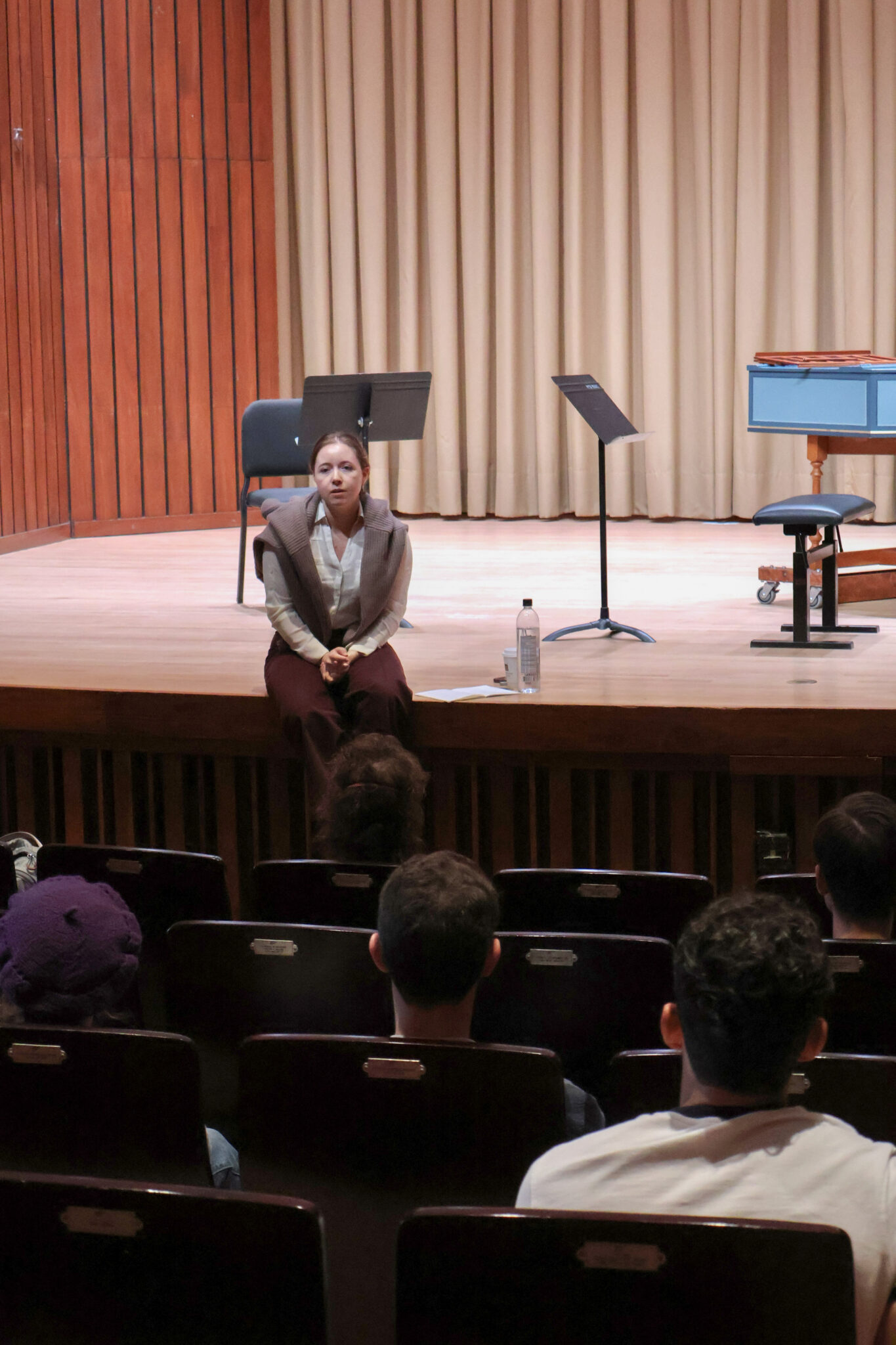
Francisco grew up in the United States Midwest and attended a very small college, where she was the only voice major in her year. She developed the concept behind the talk while working on her doctorate in Indiana, when she was asked to teach an undergraduate class for non-music majors. She built the class around what it means to involve music in a career, regardless of the field.
She sorted music careers into three groups: performing, the music industry, and “music-adjacent” work, meaning fields where music knowledge is a specialist skill. Her examples included audiologists who help musicians keep working as their hearing changes, and copyright lawyers who deal with performance videos. Even in performing, she said, “most people who consider themselves professional or full-time performers have a lot of different income streams,” including teaching and administration.
Taylor Campbell, a fourth-year voice student in the bachelor of music program, said the “music-adjacent” in the title intrigued them. A performance degree can make performance feel like the only option, they said, but the talk offered “a different perspective: here’s what you can do with a performance degree that’s not just performance.” Arts administration, in particular, “isn’t really talked about or promoted to you,” Campbell said. “Thinking of it in that different way was really interesting.”
In an interview with The Argosy following the talk, Francisco said the pressure on musicians comes from two directions. Some musicians believe you are not a professional unless performing is 100 per cent of your income. Others see you perform and wonder what else you do to get by, “because a lot of people do know how hard it is. So it’s definitely a complicated industry, and everybody figures out their own balance between performing and other things.”
She added that people are more accepting of mixed careers than they used to be, because side work is common in many fields. “There is no one career path that any of us are chasing,” Francisco said. She noted that musicians have strong analytical skills, including aural analysis, visual analysis, and pattern recognition. “These branch out into any number of tasks in different sectors, and I think they’re really important.”
Francisco compared her own experience to Mt.A. She attended a liberal arts college with a tiny music program, which gave her access to faculty, the school’s network, and a liberal arts education, allowing her to explore different interests. Larger schools “may offer things a small one doesn’t,” she said, but “those programs are missing something too. I think everybody should explore as many interests as they possibly can, and places like Mt.A are a good place to do that.”
Professor Linda Pearse highlighted this as well in the email to The Argosy, emphasizing the department’s focus on mentorship, which allows more contact with faculty, the opportunity to take part in faculty research and creative projects, and a “warm community in which every student matters.” She added that the level of mentorship offered is one “that, at larger institutions, only graduate students can access.”
During the talk, students expressed their anxiety about how long it takes to find work after graduation. Francisco said her strategy depends on what her priority is at that moment. At first, that might mean finding ways to support yourself, even through work unrelated to music. Slowly, other things get added, some fall to the side, and that makes room for new things you want to do. “It’s a little like getting on and off the highway,” she said.