Reflections and silence shared during a vigil honouring transgender lives
A vigil observing Transgender Day of Remembrance (TDOR) was held by Catalyst, Mt.A’s 2SLGBTQIA+ advocacy and social group, on Friday, Nov. 20 at the University Chapel.
A group of students, community members, and Catalyst members gathered to remember transgender people who lost their lives to anti-transgender violence throughout the year.
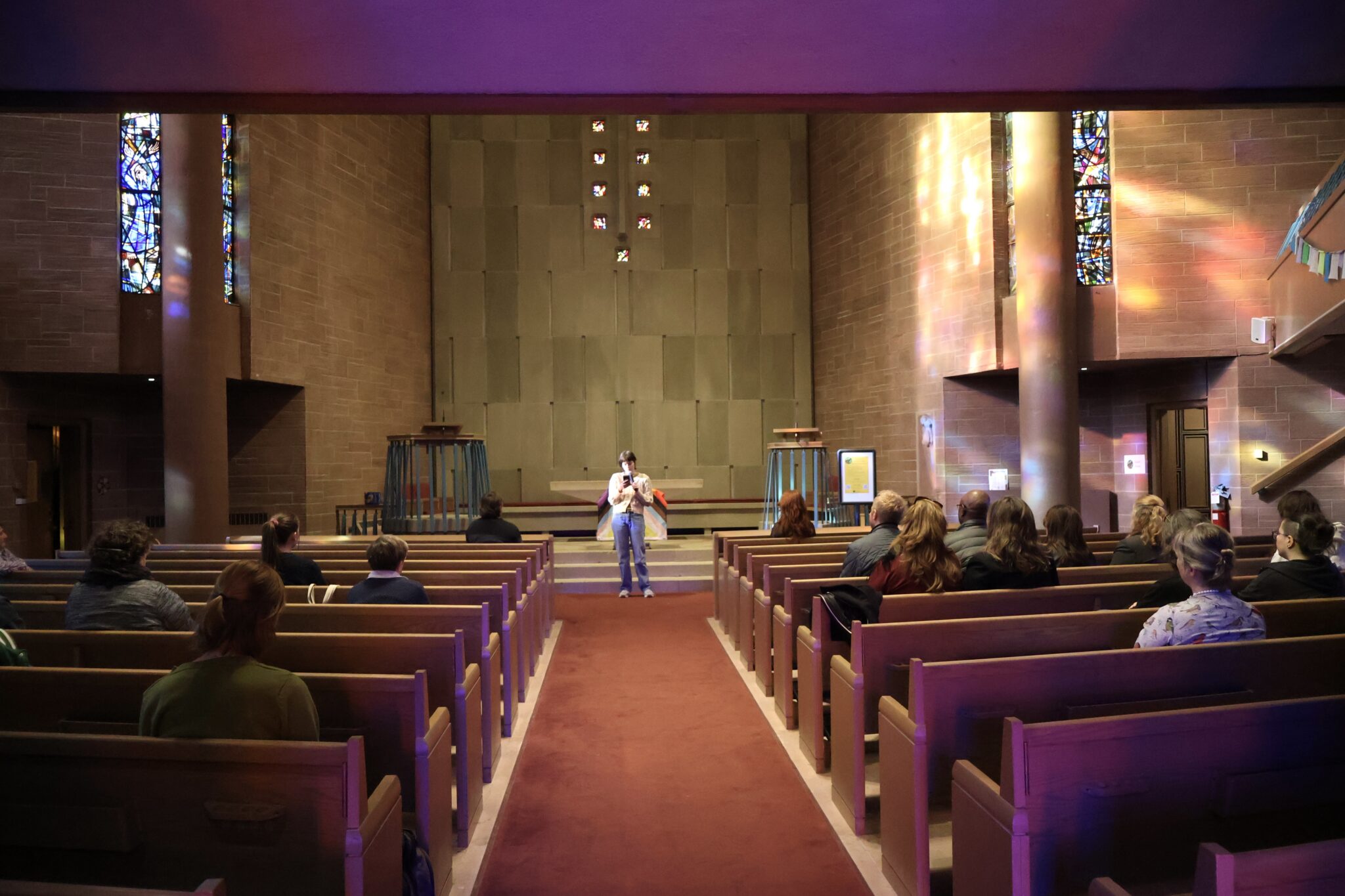
“It is really easy to fall into despair,” Catalyst president Ellen Piasenten said at the beginning of the vigil. Piasenten spoke about remembering to have hope, working to change policies that target transgender people, and “if you are trans, to stay alive, please. You deserve to have a future.”
TDOR began in 1999, when transgender advocate Gwendolyn Ann Smith held a vigil for Rita Hester, a transgender woman who was murdered in her Boston apartment the year before. The vigil grew into a day that is recognized globally, marking the end of Transgender Awareness Week. Despite annual gatherings on TDOR, Hester’s murder has never been solved.
Piasenten began the discussion by speaking about anti-transgender policies and rhetoric visible around the world. New rules in England’s hospitals state that patients should be placed in wards based on biological sex, not gender identity. In the recent United States midterm election, Arizona, Colorado, Nebraska, and Washington voted to bar transgender athletes from competing on female sports teams.
“[The] situation is absolutely dire,” Piasenten said.
Two speakers shared reflections with the crowd.
One spoke about growing up transgender in small-town New Brunswick, finishing with a call to action: “Love should be dominant in every aspect of life.”
The other speaker read a poem by transgender poet Kai Cheng Thom, titled “trauma is not sacred.”
“Violence is not special pain,” the speaker read. Soon after, the poem says: “you are more than the things that hurt you / you are more than the people you have hurt.”
The group sat in silent reflection following the speakers’ words and readings. Light came in through the stained glass windows and softly moved across the walls. Then, people began to slip out of the doors. Some stayed, quietly speaking to friends or sitting side by side. The silence remained as a single candle burned at the front.
The Argosy spoke with Ellie Hummel, Mt.A’s multi-faith chaplain and spiritual care co-ordinator, about the significance of holding a TDOR vigil in the chapel.
“A lot of Christian communities, sadly, are still very transphobic,” Hummel said. “It’s more okay to be hateful these days. There’s sort of a permission to hate … I guess I would counter, if we have permission to hate, we also have permission to love; let’s be explicit.”
Hummel also spoke about finding bravery in times of fear. “If you’re somebody whose existence is being threatened, or is told ‘you shouldn’t exist’, or ‘you don’t even exist,’ it’s much harder,” she said. “But I still would encourage people, like, one thing. Find the one person. Do the one small next step that feels right.”
“I will sing you a litany / of reasons to be alive,” the poem and its reader stated during the vigil. “There is a love poem waiting / deep below.”